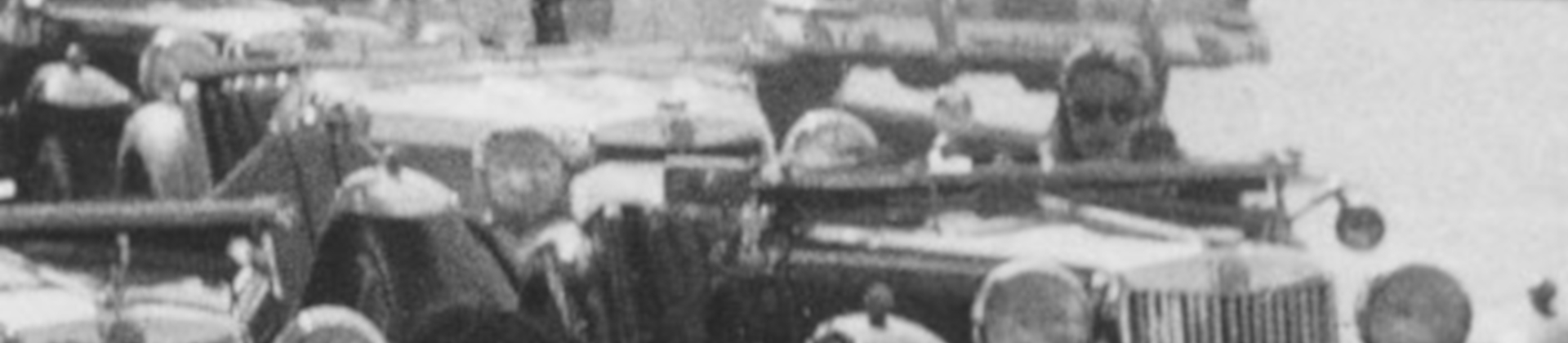
Header image: The only known photo of Terry Mason
TCMG History Part Three: 1956 – The Dark Days
By Steve Simmons
As we approach our 70th year it sometimes feels like TCMG is infallible, but things weren’t always so certain. Of the many personalities who have played important roles in the history of this fine organization, one in particular became vital to its very survival back when things had just barely even begun.
Throughout 1955 the club had seen many successful activities and the future looked bright. But in 1956 when our elected president Bill Harpe moved away, the briefly leaderless group started to fall apart. A meeting or two were held early in the year, and then things ground to a halt.
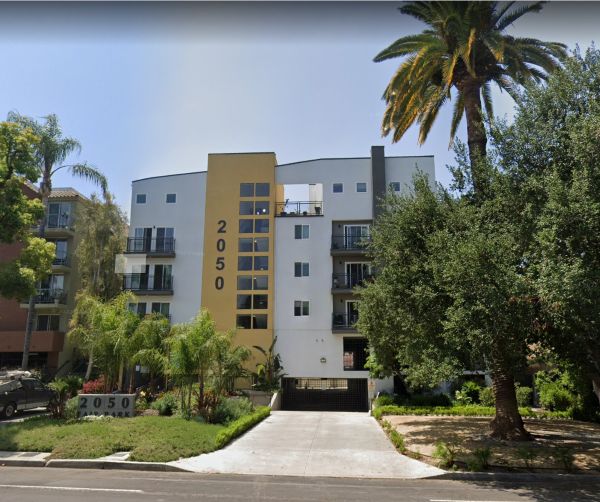
It was Terry Mason, then secretary of the club, who saw what was happening and took action. For the next several months she alone collected dues, organized what few activities she could, and by August had renewed enough enthusiasm to allow another meeting to be held. The first in about six months, it was held at 2050 Fair Park Avenue, Los Angeles in what is now known as Eagle Rock. The turnout was poor, there was no entertainment scheduled, and with so few regular members present little business could be conducted. There were some new members present and it was explained to them what the club stood for and what our activities were. A vote was then taken amongst those present to see if they wanted to continue re-energizing the club. The vote was a unanimous “yes”.
In September another meeting was held at the same location. Things were getting back to normal with refreshments served, and both color movies and slides were shown by Ron Simon and Glen Nelson. Like Terry, Ron also seems to have taken great interest in saving the club and would put in more than his share of work throughout the coming months. Dues were collected at the meeting and two new badges were sold. This allowed the previously depleted club treasury to pay off the last of a year-old debt to the badge manufacturer. Clinton Rhoda offered the use of his mimeograph for future meeting notices, which was much appreciated by Terry and may have jump-started the planning of our club newsletter. A run to the Pomona Road Races was scheduled for the following month, and eventually the meeting adjourned to the street to look at the cars and discuss upholstery.
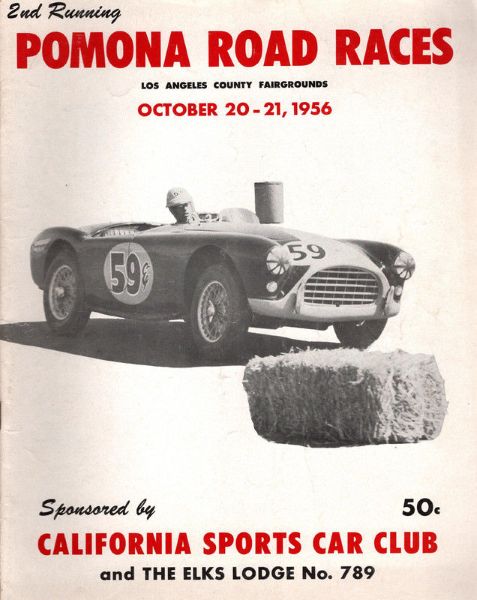 The event in October saw nine TCs on a run to the road races at Pomona where they received a lot of attention. The Hollywood Citizen-News newspaper took photos (anyone have a copy?) of the group driving down the road. Those with tops up were relegated to the rear as the photographer hung out the back of his T-Bird convertible to take photos of the caravan. After Breakfast at Bob’s Big Boy the group continued to the raceway where the cars were parked together in a line.
Terry stayed with the cars and overheard countless people complimenting the line of TCs, some saying they couldn’t believe there were so many! The only downside was that no one thought to bring membership applications, but several prospective members were added to the mailing list.
The October meeting was moved to 4271 Verdugo Road, Apt. 2 in Los Angeles (today a neighborhood known as Somerset). This time there was a strong showing of both old and new members. Gary Mechsner showed photos taken of race cars, which were of surprising quality considering he took them on his Brownie. More dues were collected and two more badges sold. The Pomona run was enjoyed so much that a unanimous decision was made to hold more race runs. A TC was offered for sale and elections for a new council were planned for November. The evening ended with discussions on tires and steering problems.
Some members gave Terry their phone numbers to be informed of last minute events. Once such event occurred between the October and November meetings when four members, including Ron Simon, who were attending an M.G.C.C.A. rally, decided to participate in the next morning’s Concours at the Huddle on Wilshire. The Huddle appears to have been a coffee shop, which today seems a strange place to hold a concours show but back then more than one restaurant in the area held them. Terry called several members around 8AM on Sunday morning, some who were not too pleased with her. But she did manage to get one to come out and join three of the cars from the previous evening’s event. Frank Mason and Larry Levin showed up later and the group ended up getting permission to move all the TCs together behind the concours. Picking up a new member along the way, five or six TCs were parked in a line and got a lot of admiring looks as they drove together through the cars and spectators. This time they had blank applications with them, which Frank was very happy to receive.
The meeting in November returned to East Glenoaks Manor for the first time since 1955 and much was accomplished that evening. It began with a discussion on our articles of incorporation, which apparently weren’t filed by the deadline the year before so it was thought we weren’t incorporated after all. It was decided that incorporation wasn’t necessary at that time but all surviving records indicate that the club was in fact incorporated in 1955, so Terry may have been mistaken.
A new badge was considered, and from the meeting minutes I quote: “Some think that the club should have a real fancy one because T.C. owners are generally snobs and something special. Others thought the one we have is fine as T.C. owners are generally broke.”
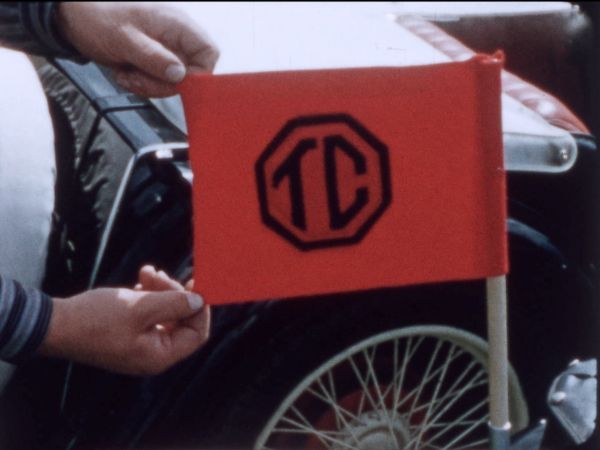
Jacket emblems were another item being discussed, and it was at this meeting that the idea for club flags to attach to the cars on runs was thought up. You can see these flags in some early photos, and especially in the film footage of our first Conclave in 1957 where all cars are flying them. At first however, they would be used to identify the lead car on driving events.
A rally team was assembled at this meeting to compete in the Lockheed Rally on December 1st, and a run to a San Diego area road race was planned for January 19-20. Ron Simon was also looking into the first TCMG booth at “the Auto Show” and volunteered to get the club some publicity in Los Angeles newspapers. If has been suggested that the auto show was held at the “Hollywood Exhibition Building” on Sunset Blvd and also may have been the L.A. Auto Show at the 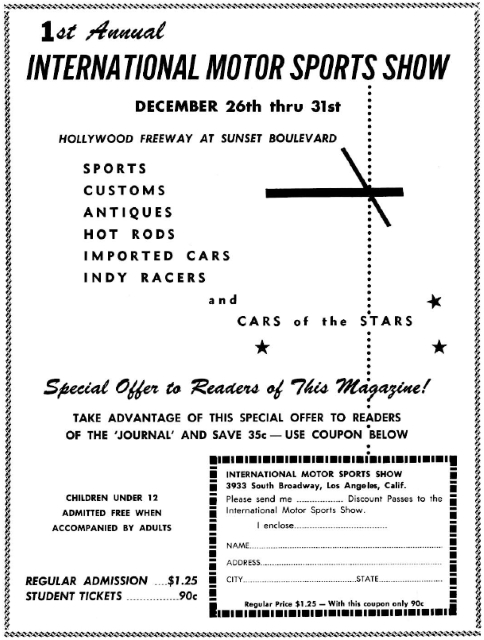 Pan Pacific Auditorium, but more likely it was the 1st Annual International Motor Sports Show held Dec. 26-31, 1957 at Hollywood Legion Stadium, which had just been announced and was accepting entrants.
A vote to create a club newsletter was passed unanimously, which Terry Mason would soon begin working on. The idea was to benefit those who lived out of state, or who had work or school on Thursday nights (now the standard meeting night). Yes, it was a younger crowd back then!
Ron Simon discussed the benefits of creating a parts center, for the purpose of sharing parts with club members. He and Terry would assemble the information and distribute it to the group. Frank Mason put our club information in Badge Bar Journal and at least seven letters were received in response, four of them from out of state.
It was also at this meeting that a unanimous vote passed to allow TA and TB owners into the club, simply because they are so identical to the TC. It seems this was rescinded and reinstated many times over the years, some arguing it’s merely a minor bending of the rules while others find it in conflict with our status as the world’s only one make, one model TC club.
A scrapbook of photos, newspaper clippings, events entered, etc was set to be created (this book may be one still in our archives) and both photo and film projects were also planned. The club was hopping indeed, but money problems still loomed so a free meeting place was again sought. The home of Jim and Gloria Bradeson was offered for the January meeting. Elections were postponed (believed until January) due to the absence of the current president and most of the older members. 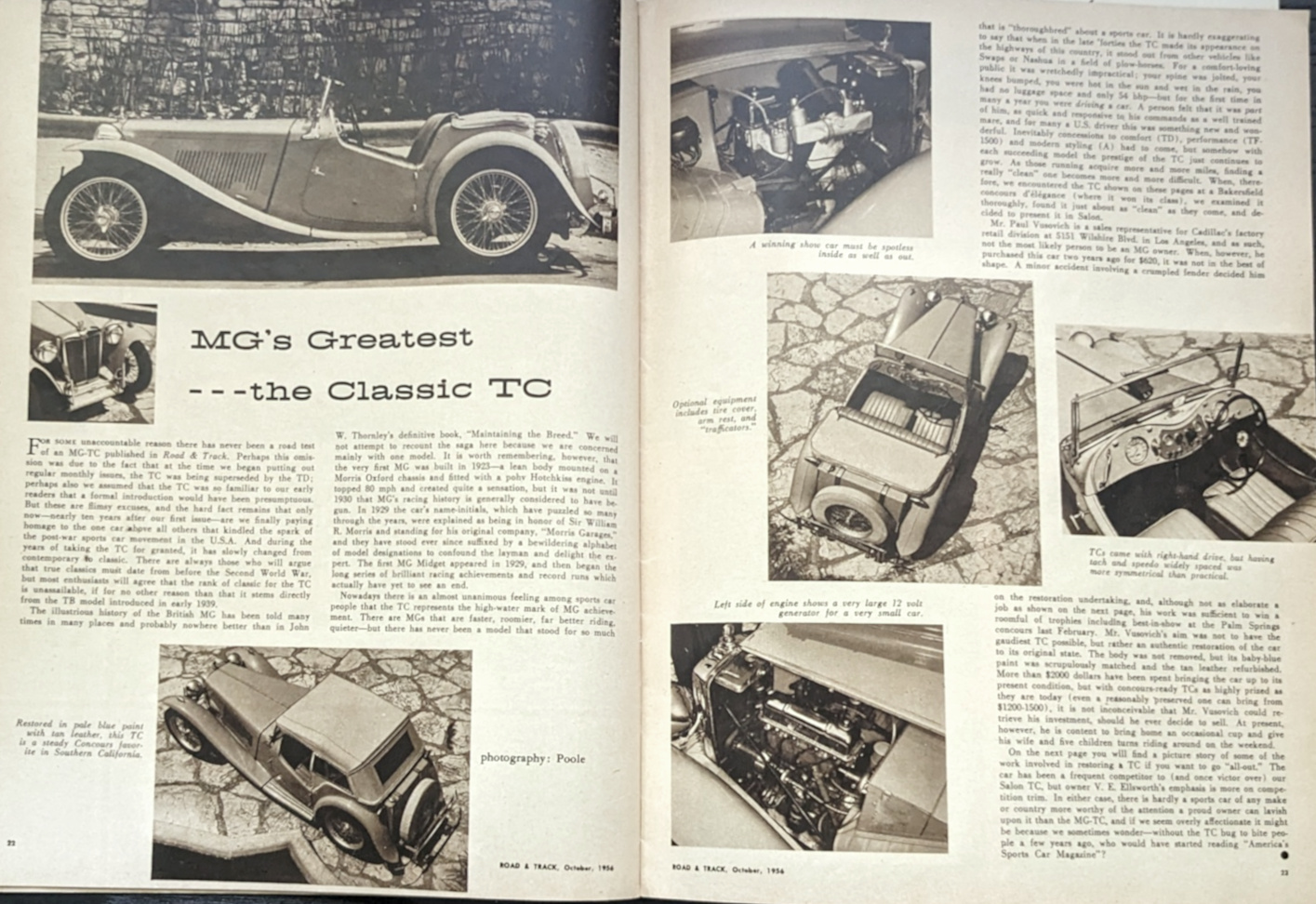 One of the last items of discussion was a possible entry in the Rose Parade, but the problem of overheating arose and rather squelched the idea, at least for the time being.
Our by-laws were at last finalized and offered to the group by Terry, and the evening concluded by agreeing to write John Bond a letter of thanks for his fine article on TCs recently published in Road & Track.
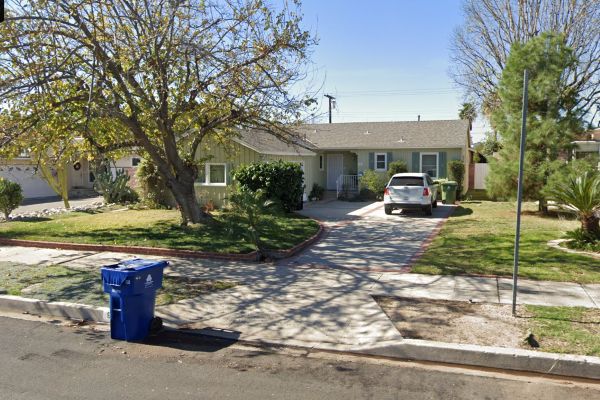
As expected, the December meeting was rather small due to its proximity to the holidays. It was also noted that the location of Granada Hills was “difficult”. It was held on December 27th at member Gene Simon’s home, located at 9701 Odessa Avenue. The meeting began with Gene promising to get the club some publicity in Motor Racing by submitting a notice about our next run to Pomona Raceway.
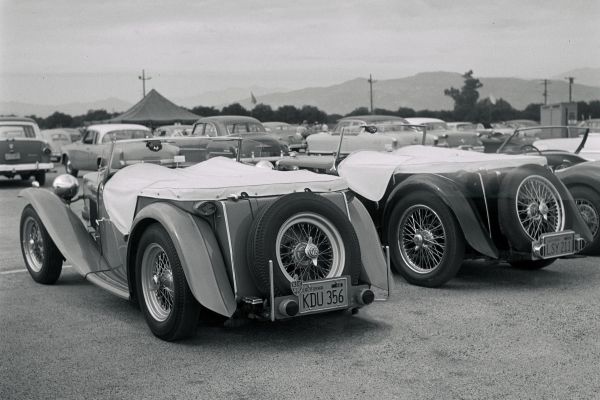
Discussion was also held on letting in all models of M.G.s earlier than 1950. There was significant opposition to this idea, as there has been every time the idea has been proposed throughout our history. The same argument was made in 1956 as in recent years, that this club is special because of its status as a single make, single model club. But at this meeting it was taken a step further, with discussion on limiting membership to those picked and chosen! The argument supporting the idea was that this is not a social club. Obviously times have changed in the past 70 years. Lifelong friendships have been made and there aren’t TCs on every corner anymore, so the club has evolved and adapted as necessary. As with the idea back in 1954 to limit membership to 50, this motion too, seems to have been defeated.
Through a connection of Gene Simon, a permanent meeting place was offered to the Guild at Beverly and Fairfax by Harry Givens, commonly known as “Hi-School Harry”. The meeting minutes of December, 1956 state, “A permanent meeting place has been offered to us at Beverly and Fairfax with plenty of parking facilities. It is a new club opened by Hi-School Harry for the main benefit of sports car owners. Neither eating nor drinking would be required or expected, and we would be given first choice of whatever date we wished.” A vote on this was planned for January. The minutes as recorded were a bit misleading however. The new club, Grand Prix Restaurant, would not open for a few weeks in approximately February 1957, and it was actually owned by Harry’s friends Bob Drake and Mary Davis.
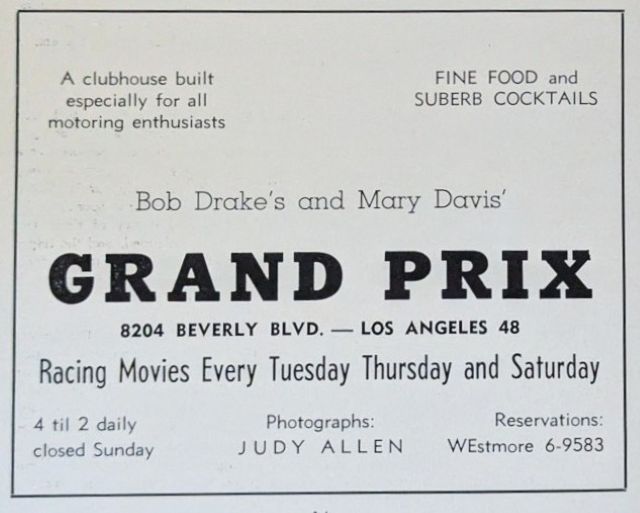 Historical sideline regarding Bob, Mary and Hi-School Harry’s racing and taverns:
Bob and Mary were a powerhouse husband-and-wife duo who stood at the absolute pinnacle of the 1950s Southern California sports car road racing scene. As Cal Club racers, entrepreneurs, and local icons, they helped shape West Coast car culture by bridging the gap between professional motorsport and Hollywood nightlife. Bob was an accomplished professional racing driver, naval diver, and Hollywood stuntman, and is remembered as the last man to ever race the legendary Maserati 250F in a Formula One World Championship Grand Prix. He also worked as a precision driver for several Hollywood movies including The Love Bug. His wife Mary was the West Coast’s number one female racing driver. She routinely won the “Ladies’ Races” driving the exact same high-powered Aston Martins, Mercedes-Benzes, and Ferraris her husband raced in the main events. Located at 8042 Beverly Blvd., the restaurant was designed specifically to be a sanctuary for their fellow racing drivers. Filled with racing photography, trophies, and automotive elite, it served as the definitive “watering hole” where figures like Carroll Shelby, Phil Hill, and local tavern keepers like Hi-School Harry would congregate to swap racing stories.
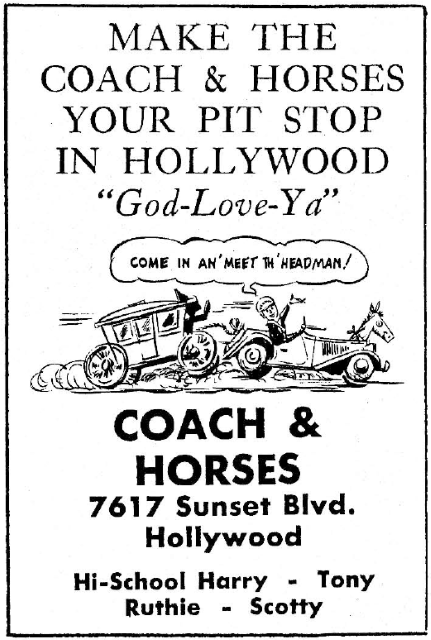 Hi-School Harry himself owned Coach & Horses Tavern at 7617 Sunset Blvd. in Hollywood. Real name Harry Givens, he was a racing driver, mechanic, and prominent social fixture in the 1950s Southern California road racing scene. He and his wife Carol purchased the restaurant, originally opened in 1937, sometimes around late 1954 to early 1955. When their weekend racing activities wrapped up, the tavern became the unofficial, post-race “clubhouse” on Sunset Boulevard. Drivers, mechanics, and local sports car enthusiasts would head straight to the tavern to grab a pint, talk shop, argue about gear ratios, and celebrate their victories. It was also a favorite hangout for many of Hollywood’s elite including Alfred Hitchcock, Jim Morrison and numerous others. In the 1990’s, Quentin Tarantino and Tim Roth famously scribbled scenes for Pulp Fiction on cocktail napkins inside the weathered bar. Harry sold the tavern in 1958 to a man whose sister and her husband, Jane & Bob Grant ran the business. Jane inherited the tavern after her brother died and continued to run it until 2010 when the neighboring bookstore who owned the property forced them out. Today the building houses a bar named “Horses” in honor of the previous 73-year venture there.
Steering was once again discussed, but it became in-depth enough that it was put on hold until the next month when a more thorough discussion could be had. The night ended with discussion on New Year’s parties, cameras, the original purpose of the club and how to get people interested enough to come to meetings.
With only three days remaining in the year, Terry continued her efforts to keep the ball rolling. Up to now mailings were generally meeting and event notices, sometimes with a bit extra thrown in. Working through the new year, Terry assembled the first TC Motoring Guild newsletter in the traditional sense, which included the minutes from the December meeting (which she recorded) along with planned future activities. It was mailed in early January and would mark the start of a banner year for the club, one that would set the tone for decades to come. But that’s a story for another time.
Surely I can speak for all of us when I say that I’m grateful for Terry’s efforts to save what she knew could become an important institution in the hobby. A club that, nearly 70 years later, still works to preserve and honor an important part of automotive history – the venerable MG TC.